
School of
Medical Laboratory Science
Program Mission Statement:
Lexington Health School of Medical Laboratory Science mission is to provide superior education to future medical laboratory scientists by integrating theoretical concepts with clinical experiences. The program is committed to prepare the student with the skills, knowledge, and technology that are required to fulfill professional roles and leadership positions. Program curricula develop the student's communication skills and analytical reasoning. The program is committed to providing students with resources for success as they begin their new positions as members of the health care team.
What do Medical Laboratory Scientists do?
A medical laboratory scientist is a healthcare professional who performs chemical, hematological, immunologic, microscopic, and bacteriological diagnostic analyses on body fluids such as blood, urine, sputum, stool, cerebrospinal fluid, peritoneal fluid, and synovial fluid, as well as other specimens. They perform a full range of laboratory tests to uncover diseases such as HIV, diabetes, and cancer. Common tests performed are complete blood count, comprehensive metabolic panel, electrolyte panel, liver function tests, renal function tests, thyroid function tests, urinalysis, coagulation, lipid profile, blood type, semen analysis, serological studies and routine cultures. They must recognize anomalies in test results and know how to correct problems. They monitor, screen, and troubleshoot analyzers featuring the latest technology available. The MLS performs equipment validations, calibrations, quality control, statistical control of observed data, and interpretation and correlation of test results.
Where do they work?
Careers in medical laboratory science are available in hospital laboratories, public health laboratories, forensic laboratories, reference laboratories, molecular diagnostics, veterinary offices, physician offices, management, pharmaceutical industry, medical sales, and educational or research institutions. In hospital laboratories, medical laboratory scientists often work in departments such as blood banking, chemistry, hematology, immunology, and microbiology. Some medical laboratory scientists are generalists and others have specialized in one area performing more complex analysis.
Career Opportunities
Medical laboratory scientists are in extremely high demand, according to the American Society for Clinical Pathology (ASCP).
National Accreditation
The Lexington Health School of Medical Laboratory Science is accredited through the National Accrediting Agency for Clinical Laboratory Sciences (NAACLS) since 2003.
NAACLS
5600 N. River Road
Suite 720
Rosemont, Illinois 60018
(773) 714-8880
www.naacls.org
Program Overview
The Program is 11.5-months in length beginning each August. No more than five students are enrolled at a time, allowing for a 1:5 instructor to student ratio in lecture and a 1:1 instructor to student ratio in the clinical laboratory.
Class and Clinical Schedule
The program combines clinical experience with classroom instruction to ensure reinforcement of theoretical concepts. Classroom and clinical experiences are generally scheduled weekdays from 7:00 a.m. to 3:30 p.m.
Lectures are held twice a week (Monday and Thursday). Clinical rotations are conducted three full days a week (Tuesday, Wednesday, and Friday) and Monday and Thursday mornings. The program uses the facilities of the Lexington Health Main Laboratory to provide the clinical experiences for its students. The program does not have any academic or clinical affiliates or any partnerships. Placement in clinical laboratory rotations is guaranteed.
Curriculum
- MLS 405 Clinical Hematology (5 credits)
- MLS 410 Clinical Hemostasis (3 credits)
- MLS 415 Clinical Seminar (4 credits)
- MLS 420 Clinical Chemistry (5 credits)
- MLS 425 Clinical Microbiology (6 credits)
- MLS 430 Parasitology (2 credits)
- MLS 435 Mycology (2 credits)
- MLS 440 Urinalysis and Other Body Fluids (3 credits)
- MLS 450 Blood Bank and Transfusion Medicine (5 credits)
- MLS 455 Clinical Immunology (4 credits)
Course Descriptions
Detailed course descriptions are published in the MLS Student Handbook and in the Information for MLS Applicants document. The Information for MLS Applicants document is emailed to prospective students with the application packet. The MLS Student Handbook can be e-mailed to a prospective student upon request. Please contact the Program Director for more information or to request a copy of the MLS Student Handbook.
Faculty
The didactic lectures are taught by the Program Director and medical laboratory scientists with proficiency in their content area. Board-certified pathologists and laboratory supervisors serve as additional didactic instructors. Each clinical rotation has a coordinator who directs the bench instruction.
Program Administration
Program Director - Tiffany Smith, MS, MLS(ASCP)
Lecture Course / Primary Instructor
Blood Bank and Transfusion Medicine -
Emily Austin, MLS(ASCP) CM SBB
Chemistry - Amber McClelland, MLS(ASCP) CM
Hematology - Tiffany Smith, MS, MLS(ASCP)
Hemostasis - Tiffany Smith, MS, MLS(ASCP)
Immunology - Tiffany Smith, MS, MLS(ASCP)
Microbiology - Cindy Griggs, MLT(ASCP) CM M
Mycology - Cindy Griggs, MLT(ASCP) CM M
Parasitology - Cindy Griggs, MLT(ASCP) CM M
Urinalysis and Other Body Fluids - Tiffany Smith, MS, MLS(ASCP)
Clinical Rotation Coordinators
Blood Bank and Transfusion Medicine - Stephanie Goe, BB(ASCP) CM
Chemistry - Amber McClelland, MLS(ASCP) CM
Hematology/Hemostasis/Urinalysis - Leah Schmalfuss, MLS(ASCP) CM
Immunology - Martha Lee Sitnik, MLS(ASCP)
Microbiology - Cindy Griggs, MLT(ASCP) CM M
Program Completion
Upon successful completion of the program, students will possess entry-level competencies of a medical laboratory scientist and are eligible to sit for the American Society of Clinical Pathologists (ASCP) national certification exam. Each student is awarded a certificate upon successful completion of the program. Graduation from the program is not contingent upon passing a certification exam. Program Goals and Competencies
National Certification
National certification as a Medical Laboratory Scientist is recommended upon graduation but not required to complete the program. American Society for Clinical Pathology (ASCP) offers the MLS certification exam and students may sit for the exam locally. Students undergo two weeks of intense review at the conclusion of the program to prepare for the ASCP Board of Certification MLS exam.
Past 3-year Outcomes
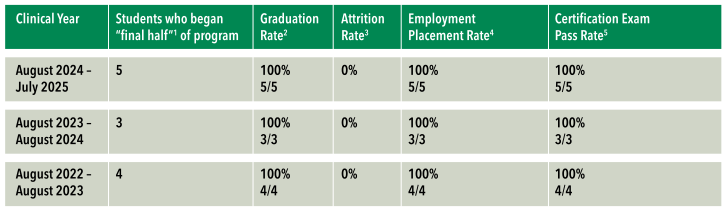
1"Final half" of the program starts on February 1st of the year of graduation.
2Percentage of students who began the "final half" of the program that successfully graduated.
3Percentage of students who began the "final half" of the program but failed to complete the program.
4Percentage of graduates who found employment in the field or continued their education within one year of graduation.
5Percentage of graduates who passed the ASCP BOC MLS exam within one year of graduation.
Program Requirements
The School does not offer advanced placement, transfer of credits, or credits for experiential learning.
Academic Acceptance Requirements
1. Applicants must have a bachelor's degree from an accredited college or university in biology, chemistry, microbiology, biochemistry, or a related health science.
Curriculum Prerequisites:
a. 16 semester hours of biological sciences to include microbiology with lab, human anatomy and/or human physiology, and immunology (either as a separate course or as part of a microbiology course - provide course outline or syllabus).
b. 16 semester hours of chemistry to include organic chemistry or biochemistry with labs
c. One course in college level mathematics. Statistics is recommended.
d. Recommended courses include genetics and molecular or cell biology.
2. Minimum GPA of 2.75 on a 4.0 scale and 2.8 GPA in core biology/chemistry courses.
Note: Online courses are not acceptable for any course that requires a lab component.
The chemistry and biological science courses must be acceptable towards a major in those fields of study. Survey courses, remedial courses or courses designed for non-science majors are not acceptable.
The following courses must have a grade of “C” or better: microbiology, immunology, organic chemistry, biochemistry.
Updating Course Work:
Organic chemistry or biochemistry and microbiology coursework must be updated if course(s) were not completed within 7 years of the program start date. Applicants can complete either organic chemistry or biochemistry to meet the updated chemistry course requirement. Courses must be acceptable towards a science degree and must include in-person labs. A grade of "C" or better must be achieved in each course. Courses must be completed before applying to the MLS program.
Non-Academic Requirements:
Students must have the ability to perform the essential functions required of a medical laboratory scientist to be admitted in the program. View Essential Functions for Medical Laboratory Science Students
The applicant is required to affirm in writing their ability to perform the essential functions.
Graduates of Foreign Colleges or Universities
Individuals who hold degrees from foreign colleges or universities and who wish to enter the program must provide documentation that they are legally eligible for employment in the United States and must satisfy the following criteria.
1. Transcript must be evaluated for U.S. equivalency using an ASCP approved agency.
2. Complete at least 12 semester hours at an accredited U.S. academic institution before applying to the MLS Program. Required courses will be determined by the Program Director and may include, but are not limited to, microbiology with lab, human anatomy/physiology, biochemistry with lab, immunology, and genetics.
3. Test of English as a Foreign Language (TOEFL) taken within the last two years. Required internet scores for acceptance into the program: reading ≥23; listening ≥23; speaking ≥26; writing ≥23; minimum total score ≥100. A minimum paper score of ≥600 is required. An official score report must be sent directly from ETS to the Program Director.
Application Procedure
Apply
To request an application packet, email Program Director Tiffany Smith, MS, MLS(ASCP) at tesmith@lexhealth.org.
Application Requirements
- Completed application form
- Official college transcripts
- TOEFL score, if graduate of foreign college/university or first language is not English.
- Three references using the provided reference form. Two references must be from science instructors/professors. The third reference can be from an academic advisor or employer.
Application Deadline
The deadline to apply is the last Friday in January of the same year as enrollment.
Program Student Selection:
Acceptance to the Lexington Health School of Medical Laboratory Science will be on a competitive basis. A numerical evaluation system is used to objectively determine the suitability of each candidate for admission. Applicants are evaluated in each area of the following admissions criteria: overall GPA, biology/chemistry GPA, references, personal statement and personal interview. Interviews are held on-site and by invitation only.
Student recruitment and admission shall be non-discriminatory in accordance with state and federal regulations. All applicants are considered equally without regard to race, color, sex, national origin, religion, age, veteran status, or disability.
Post-Acceptance Requirements
Accepted students must meet Lexington Health’s Human Resource employment criteria to enroll in the program. Lexington Health is committed to maintaining a safe and healthy workplace; therefore, a negative urine drug screen, health screening and a criminal background check are required prior to the start of the program. Drug testing and the criminal background check are performed free of charge.
Fees and Expenses
Tuition Waiver
Current program tuition is $4,000. Program tuition is waived with the stipulation that the student must work full-time for 24 continuous months as a certified MLS following program graduation. Positions may be on any shift. Lexington Health reserves the right to not hire a student, which dissolves any repayment requirements. Students who do not complete the program for whatever reason, are not required to pay tuition. Since enrolled students do not pay tuition, there is not a refund policy.
Textbooks, Transportation, Housing, Insurance, and Personal Expenses
Students are responsible for the cost of textbooks, transportation, housing, and personal expenses. Contact the Program Director for current textbook list and estimated cost. Meals may be obtained in the hospital cafeteria at a discounted price. The hospital does not offer health insurance to students. Health insurance is recommended but not required.
What to wear?
Scrubs and closed toe/heel shoes are required and are at the student's expense. Students are required to adhere to the health system and laboratory dress code which is distributed during orientation. All personal protective equipment will be provided.
Program Policies
Program Withdrawal
A student may withdraw from the program at any time by notifying the Program Director in writing. Students who withdraw will not be expected to repay any tuition.
Student Employment Policy
After demonstrating competency, a student may be employed in the laboratory performing direct patient and/or reportable work outside of scheduled educational periods. Students are only permitted to work per-diem on weekends and after school hours if hours are available. Students will not be substituted for laboratory staff to perform direct patient and/or reportable work. Working outside of academic hours is paid, voluntary, and closely supervised. Students are not paid during school hours. Students are not guaranteed employment with Lexington Health during their clinical year or upon graduation.
Additional Policies of the LMC School of Medical Laboratory Science
For information concerning program policies or for examples of the academic calendar, please contact the Program Director. Program policies are published in the Student Handbook which can e-mailed to a prospective student upon request.